
Global Automotive Manufacturer
Download Case Study PDF- Implemented By:
- Asseco CEIT
- Implemented In:
- 2022
- Industry:
- Automotive
- Country:
- USA
- Customer Website:
- sewio.net/customer-projects/global-automotive-manufacturer
- Use Cases:
Fleet Monitoring
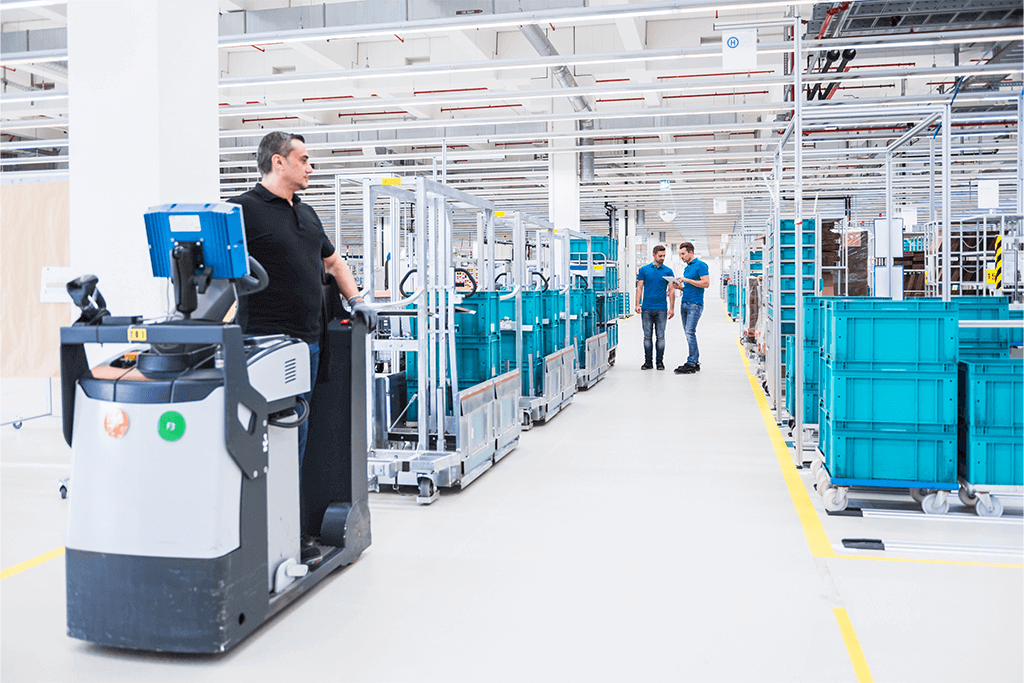
Intralogistics Optimization for an Automotive Manufacturer
Background
This US-based automotive parts manufacturer is a global leader, supplying components to major car makers worldwide. Known for innovation in smart and electric vehicle technologies, the company plays a key role in shaping the future of transportation.
However, like many in the industry, it faced costly delays and inefficiencies in intralogistics. To stay competitive, the company implemented Sewio’s Real-Time Location System (RTLS). The results? Faster production and maximum efficiency.
Goals
In the past, the company relied on manual processes for planning and monitoring of tugger routes. The managers had no real-time data on traffic, route overlaps, or loading times. And as you can imagine, this was causing delays and downtime on production lines. Production was getting too expensive.
The company needed to shift from reactive to proactive logistics. Digitalization and better planning would improve efficiency, cut delays, and reduce manual work.
The team decided to use real-time location tracking (RTLS) to get data from the shop floor. The tracking system then had to be connected to visual tools like heatmaps and spaghetti diagrams for actionable insights. Long-term, the goal was to integrate RTLS with Digital Twin, so they could plan the best routes while maintaining the milk-run supply method. A navigation system was also needed to guide operators along more efficient paths.
- Real-time locating system (RTLS) for clear data
- Heatmaps and spaghetti diagrams for visualization
- Digital Twin for route planning
- Navigation system for choosing the best routes
Challenges
The project faced two challenges in providing reliable and accurate position tracking:
- Overcoming signal interference in the metallic environment
- Ensuring seamless integration with the company’s complex systems
Solution
Sewio UWB-powered real-time locating system (RTLS) was chosen because UWB technology is reliable in metal-heavy environments. Plus, it’s scalable and designed for integration with MES and other software the company already uses. The project was implemented in stages, allowing the team to test and adjust each step as they went.
Phase 1: Installing Real-Time Indoor Tracking
The first step was to set up the real-time tracking system using UWB-powered Sewio RTLS. With the data collected, the team could begin to understand how the tugger logistics were running and identify areas to improve. Plus, the raw position data from Sewio RTLS was essential for the next steps in the project.
Phase 2: Analyzing the Data
In the second phase, the focus shifted to analyzing the data gathered from the tracking system. Using Digital Twin technology, the team got reports to examine the movement of the tugger trains, and the time spent on each task. This helped them see patterns and areas where routes and processes can be optimized.
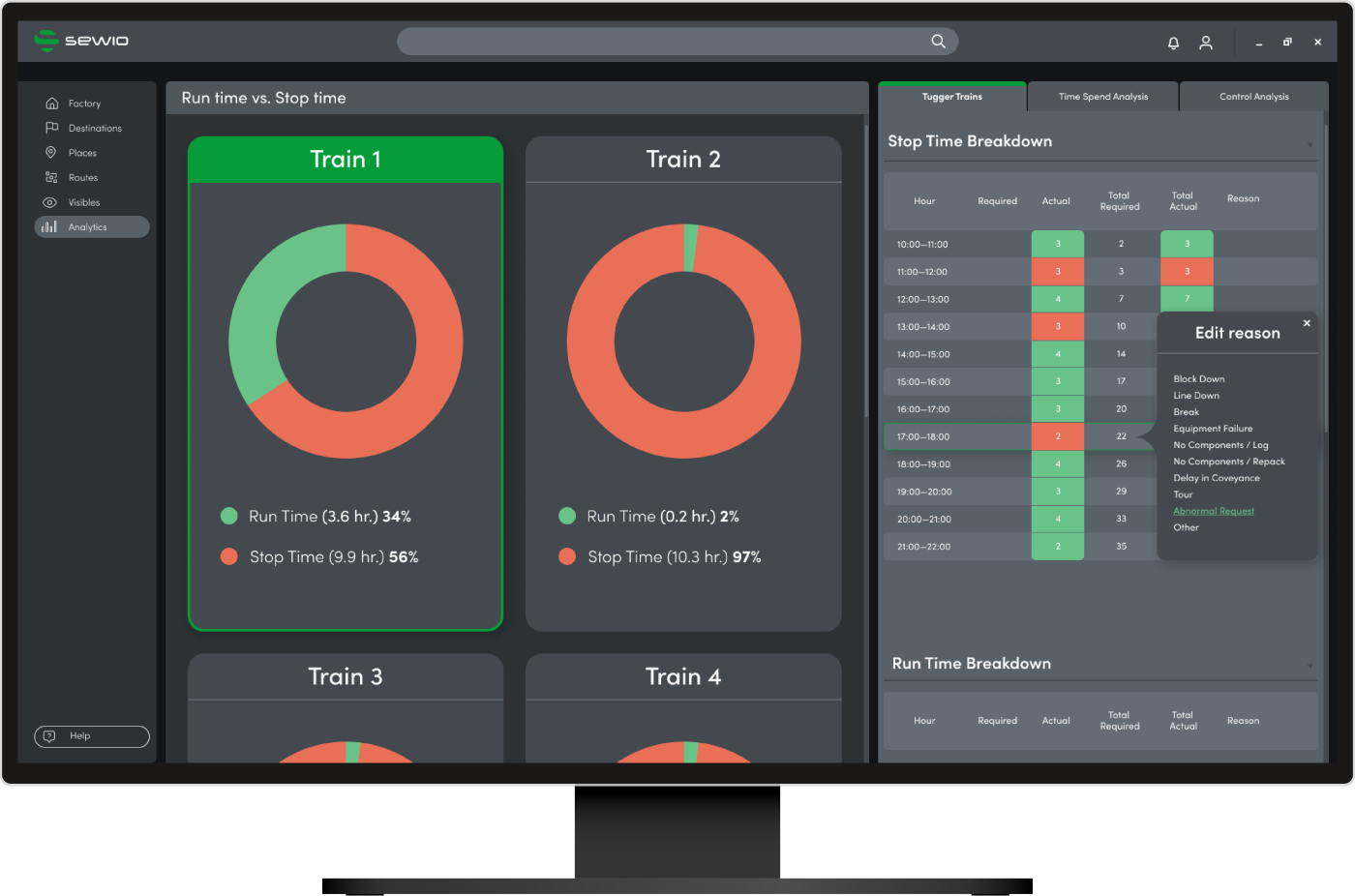
A report showing how many routes were planned and completed each hour, plus a summary of the reported reasons for delays.
Phase 3: Optimizing Operations
Next, the team used the insights from the data to optimize the logistics. They compared real-time data with ideal plans, found better ways to use resources, and reduced delays. This phase helped them fine-tune the tugger routes and logistics processes to minimize delays and cut down on production line downtimes.
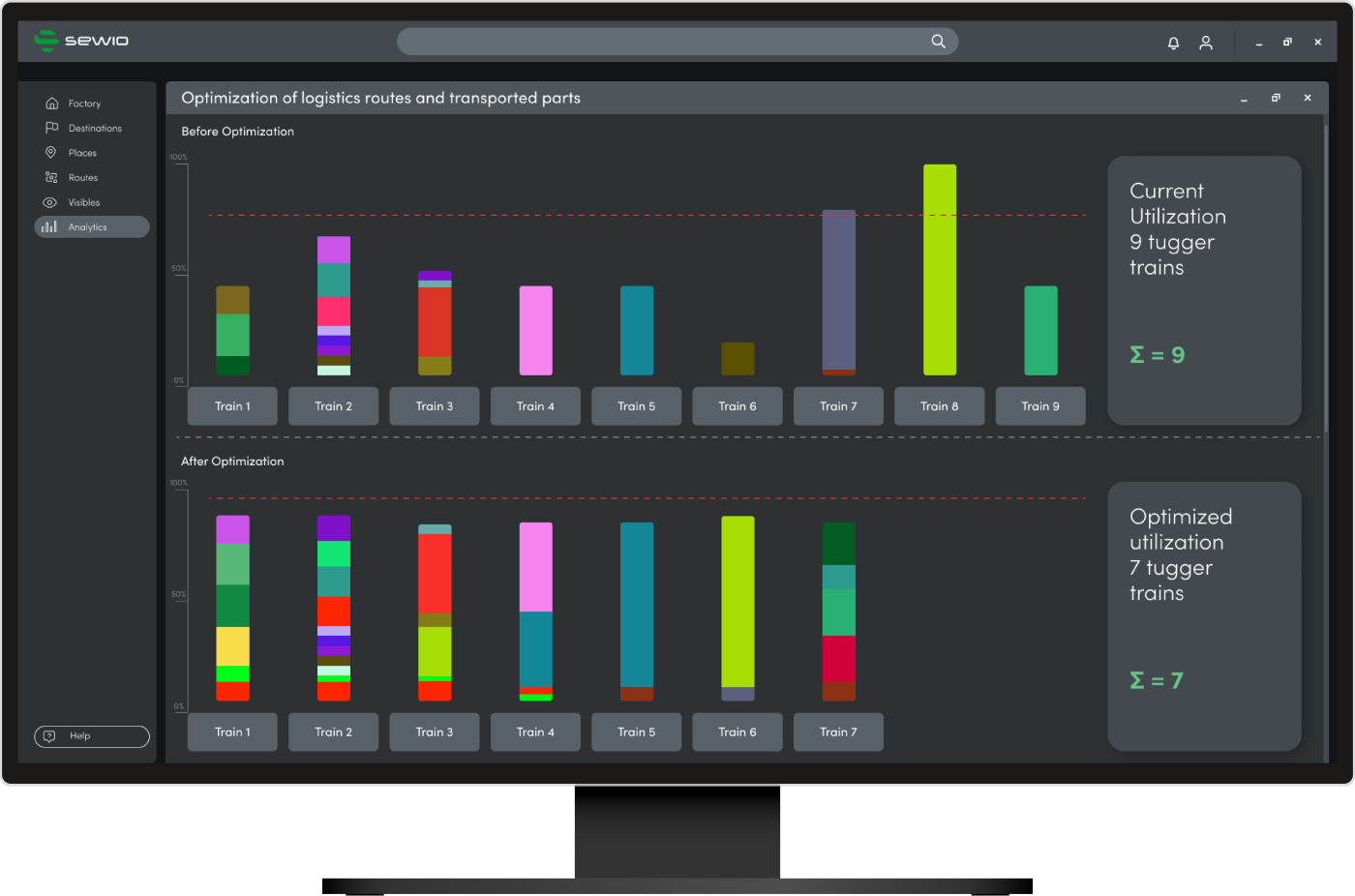
Tugger train utilization before and after the optimization leveraging data from Sewio RTLS. The company was able to remove two tugger trains while maintaining the same workload.
Phase 4: Helping the Team to Adopt the Innovation
In the final phase, custom Andon tools were introduced to help operators follow the new, optimized routes. These tools gave clear guidance on the best paths and schedules, navigating the tugger train drivers to optimal routes. This final step was key to ensuring smooth adoption of the improved logistics process.
Results
Implementing the indoor locating system was a game-changer for this company. Reducing the tugger fleet from 9 to 7 operators freed up 15% of the workforce for more critical tasks.
The project also improved training for new tugger operators. Navigational tools boosted training efficiency by 50%, enabling new hires to quickly learn the system and navigate optimized routes right away.
However, the real impact went even further! Using RTLS created a culture of Kaizen and serves as a great example of how to drive continuous improvement in the automotive industry. With 100% visibility into the supply chain, the shop floor managers can make confident, data-driven decisions. This control allowed the team to quickly evaluate changes and fine-tune operations. As a result, the weekly supply chain delays were reduced by 95%, cutting down the average delay from 18 hours to just one hour.
If you want to learn more about how to optimize milk runs and tugger trains, read the blog Optimizing Milk Runs in Intralogistics written by our CTO Lubomir Mraz.
Key criteria for choosing Sewio
- Reliable and accurate in metal-heavy environment
- Low-power transceivers
- No interference with other radio communication systems
- Modularity and scalability of the system
- Availability of raw position data for further use
- Full Digital Twin support
Utilizing the Sewio RTLS system alongside the data visualization, our team has developed tools to identify and communicate problems that were previously hidden. We now have data to address these issues and demonstrate the real impact of our improvements.”