
Toyota Motors
Download Case Study PDF- Implemented By:
- Asseco CEIT
- Implemented In:
- 2018
- Industry:
- Automotive
- Country:
- Czech Republic
- Customer Website:
- toyotacz.com
- Use Cases:
WIP tracking
intralogistics tracking
Toyota Motors Becomes the Pioneer of Digitizing Lean
Background
For decades, the Toyota Production System has been the global gold standard for lean manufacturing. Its core principle is the relentless elimination of waste, or muda, from every single process.
So, when the company that practically wrote the handbook on lean decides to change something, it’s worth paying attention. Having perfected lean, Toyota is now moving it into the digital age. And it is using Sewio Real-Time Locating System (RTLS) to do so. Their project shows that even a well-tried and tested process like Kanban can be made faster and more scalable.
Toyota’s plant in Kolín, Czech Republic, employs around 3,000 people and produces over 1,000 cars per day. Here, you can learn how to move towards a truly connected, data-driven factory.
Goals
The people behind this project, Vladimir Strnad and Josef Šafařík from the bodywork production department, had a clear vision: to bring the legendary Toyota Production System into the modern era.
As a first step, they took a close look at the car body manufacturing process and identified muda in internal logistics.
The goals were to:
- Cut down on safety stock for true just-in-time logistics
- Remove manual Kanban handling and free up workers for more value-added jobs
- Shrink their eight-hour information gap for better planning
- Prevent costly downtime with automatic alerts
- Boost safety by reducing unnecessary walking on the shop floor
Long information lead time
The inventory between the press and welding shops was done once per shift, leaving an eight-hour information gap. During the shift, no one knew if a part was lost, delayed, or just sitting there. To cover that risk, the Toyota team had to keep a large safety stock, which, of course, costs money and eats up valuable floor space.
Non-value-added work
The process was tied to Kanban cards. Workers had to physically attach work orders to pallets and put them on a Kanban board. Let’s be honest: moving a piece of paper around doesn’t make a car. It’s a classic, non-value-added step.
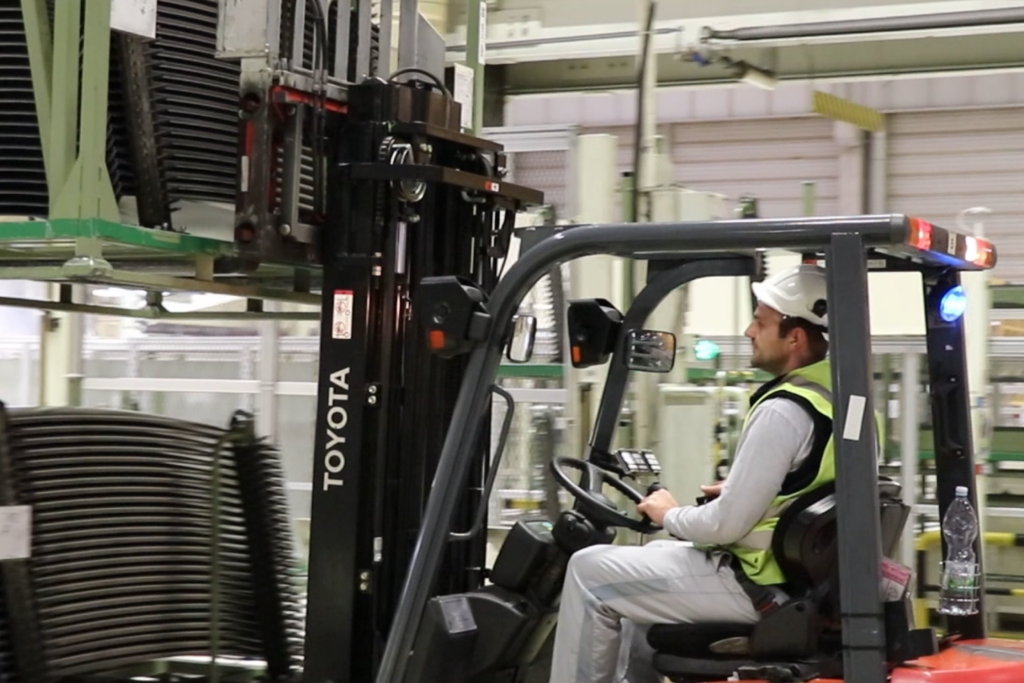
Plus, every step a worker or a forklift takes is a risk and a potential waste of time. They needed to cut down on that movement. Vladimir Strnad puts it best: “The added value of intralogistics is zero. That’s why we’re striving to eliminate it as much as possible.”
Challenges
Convincing a company like Toyota to change a system that has worked for years can be tough. The biggest hurdle was proving this wasn’t just “tech for tech’s sake” but a legitimate lean improvement. The team needed a solid business case and a project that would deliver a full return on investment (ROI) within two years.
And then there was a human element. The paper Kanban cards were a way of life. Everyone understood the system and their role in it. Take away the paper and you risk creating chaos and confusion. This could stall Kaizen, the continuous improvement everyone works so hard for.
Solution
To prove the value and hit that two-year ROI target, the Toyota team started with a pilot project. They used our Real-Time Locating System (RTLS) to monitor inventory between the press and the welding shops and replaced manual Kanban with an eKanban from Asseco CEIT.
RTLS: The backbone of digitalization
RTLS is the engine here. To eliminate paperwork and reduce safety stock, Toyota needed to automate work-in-progress tracking, see where in the process each part or material is and how it moves around the shop floor.
The halls are full of metal racks and metal pallets, so Toyota needed robust and reliable technology: our ultra-wideband (UWB) RTLS. It cuts through obstacles and delivers precise, interference-free location data. The UWB tags are protected by custom magnetic cases, so they can stick to Toyota’s metal pallets and survive the tough environment.
Now, instead of a static piece of paper, every pallet is a live Kanban card that automatically feeds its precise location into the digital system. Every time a pallet moves, its position is updated in real time. The eKanban system knows exactly when a part has been used, if it’s on its way, or if it needs to be restocked.
This changed everything. Managers and operators got a live map of their material flow. The information gap was slashed from eight hours to a single second. Just like that, the factory had true just-in-time production. “With a flow of 1,000 pallets, this represents a huge saving in storage space,” says Vladimir Strnad.
To handle the “no paper, no clue” problem, Toyota didn’t just remove the old system. They built a “Kanban dojo,” a special training area where employees use manual Kanban and get comfortable with the new digital workflow. This smart move made sure everyone understood the new process and could contribute to kaizen.
Results
The results of this project prove that while lean principles are timeless, they can be enhanced with modern technology. By putting RTLS at the heart of their operations, Toyota unlocked a new level of efficiency and visibility that was impossible with the manual system.
- Zero information gap: Information lead time was cut from eight hours to one second.
- Reduced waste: The buffer size was reduced, freeing up significant floor space.
- Freed-up labor: Streamlining the Kanban system reduced three processes and saved four employees, who were reassigned to more valuable tasks.
- Enhanced safety: Forklift drivers don’t have to leave their cabin and fewer people walk around the shop floor.
The successful pilot project was the start of a digital transformation. With the RTLS now in place, Toyota’s team is collecting a huge amount of data. The next step is to make that data work even harder.
We worked closely with Toyota to help them understand all the new use cases they could unlock with the system. The team quickly realized the potential was far larger than just digitizing Kanban. Now, their goal is to expand the project to track every piece of material throughout its entire journey. When a car rolls off the line, scanning the VIN code will give them instant access to its full history: who made the doors, when they were made, and from what material.
Toyota’s story is proof that once you get a foundation of real-time data, the opportunities for a leaner, more efficient, and fully traceable factory are endless.
Key criteria for choosing Sewio
- Robust, reliable and accurate technology
- Clear ROI through a proof-of-concept project
- Seamless integration with eKanban
- Expert partnership and long-term support
“We replaced manual Kanban with Sewio RTLS and eKanban. Thanks to this digitalization project, we cut the information lead time in our warehouse from eight hours to less than a second. That allowed us to respond quickly to issues and abnormalities. As a result, we were able to reduce safety stock from 8 to 4 hours and finally run a true Just-in-Time operation. The system paid for itself in two years, and we’re only starting to tap into its potential for many more applications.” Vladimír Strnad GL project team & digitalization, Toyota Motor Manufacturing CZ