
Digital Asset Tracking for Real-Time Visibility
Never let lost assets slow you down again. Searching for tools, pallets, machinery, or vehicles and replacing them can cost you hundreds of thousands a year. Our multi-technology IoT system gives you real-time asset visibility, so you can find what you need in minutes.
Are You Tired of Searching for Assets?
If you don’t know exactly where tools, equipment, and machinery are in your facility, or you rely on manual records, you’ve probably experienced these:
- Searching for critical tools or equipment delays production
- Costly replacements of lost equipment
- Time-consuming audits
- Slow tooling management
Our solution? An asset tracking system that automatically collects location data, so you’ll have all you need on hand at the right time.

Know Where Every Asset Is with a Real-Time Locating System (RTLS)
Asset tracking with real-time locating system (RTLS) shows you the asset's exact location, works automatically, and performs reliably even in complex, industrial environments.
The benefits will be visible from the first day: no more searching for lost equipment and workers who can focus on more productive tasks.
When you start collecting location data, you'll gain even more. The outcomes? Smoother operations, better productivity, and lower costs.
Trusted by



Industrial Asset Tracking Benefits

How Indoor Asset Tracking Works
Shine a light into the dark corners of your manufacturing facility! Manual records or spreadsheets are no longer needed. Our RTLS uses wireless technology to see around a corner, through the dark and dust, even in a metal-heavy environment. We use small wireless tags that automatically send their location data to the system. You can see the assets' location on a digital map.
Tracking Thousands of Assets
In some cases, tracking assets with tags wouldn’t be feasible. The tag might be too vulnerable on heavy coils, or the cost would be too high if you need to track thousands of assets.
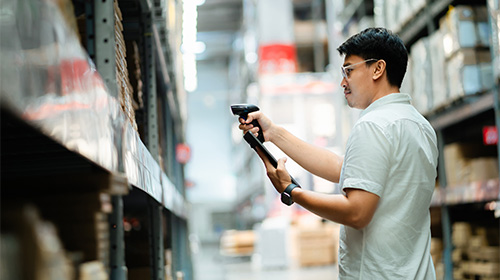
No worries, we have thought about that! In such cases, we use tagless tracking—each asset is equipped with a QR code and your material-handling vehicles do the work. A single tag with a scanner on a forklift reads the QR code on the asset before moving it, and the system automatically logs its location based on the vehicle’s position. It’s a smart, low-cost way to track thousands of assets without extra hardware.
Four Steps to RTLS Asset Tracking




Technology for Full Visibility in Complex Environments
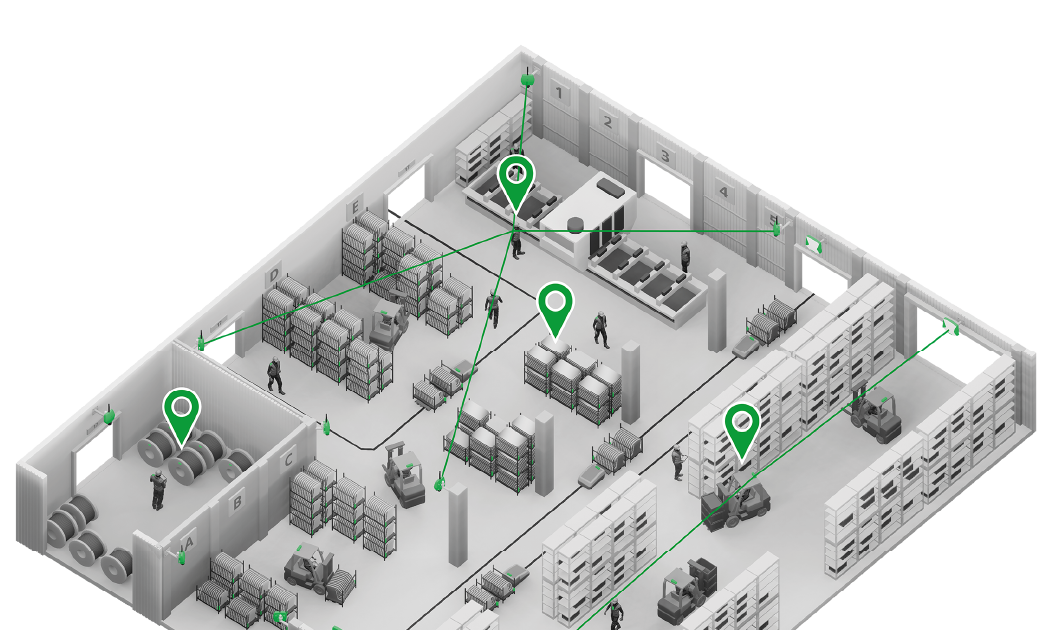
Our RTLS delivers continuous, real-time location data across your entire production and logistics areas thanks to multiple tracking technologies.
The solution has been proven in demanding environments: multi-story shop floors with tall racks, metal-heavy shop floors, and hazardous zones. Even when assets move outdoors, tracking continues, so you stay in control at every step.


Turn Location Data into Efficiency Gains
Collecting location data is a basic step towards greater efficiency. When you analyze the data and integrate your RTLS with other systems, you’ll uncover advanced applications that will help you boost productivity and cut costs.


RTLS Asset Tracking Use Cases
Full Real-time Visibility of Assets and Inventory
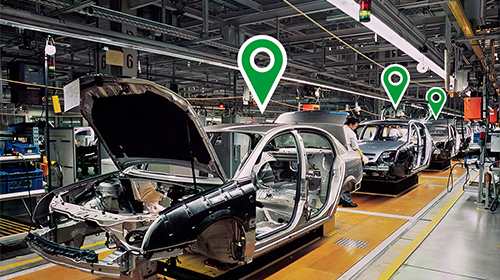
Sewio RTLS for asset tracking provides a full real-time visibility of each pallet, tool and material across your entire facility. All tracked assets are visualized on your facility plan with one-foot (30 cm) accuracy and displayed in real-time on any device. Knowing exactly where assets are greatly reduces the time spent looking for missing or misplaced assets or all rejects from a single batch.
Having full insights into where assets were in the past and what their flow across the facility was helps to plan processes better, monitor inventory, reduce search times, limit bottlenecks and streamline workflows.


Tag-less Asset Tracking Using Overhead Crane Tracking While Increasing Safety
Assets or materials and their flow can also be tracked indirectly by tracking the real-time position of the overhead crane’s hook that is manipulating them. The material is identified anytime the hook loads it and then it is tracked by tracking the hook until the unload and the data is synced with the WMS. Not only is the material flow monitored but also unloads to incorrect positions are prevented.
The same infrastructure can be used for employee tracking, increasing the safety of the workers in place by automatic alerts to the crane operator’s screen when anyone gets in close proximity to the hook.
Tag-less Asset Tracking via Tracking Handling Vehicles
In scenarios where hundreds to thousands of assets (e.g., pallets) are being transported by vehicles such as forklifts, you can achieve a better project ROI by tracking a smaller number of forklifts rather than all the pallets that the forklifts are manipulating. The trick here is to identify the pallets with cameras and barcodes or NFC technology during the loading, pair that information with the forklift, and then simply only track that forklift to be aware of the location of the pallet.
By tracking forklifts, the full real-time visibility of the material’s location and its flow within the facility is achieved while keeping the costs of your indoor tracking project at a minimum.


Real-Time Tool Tracking and Their Configuration based On Location
By having real-time asset visibility, the operators and managers both know if the right tool with the right configuration and right occupancy status is at the right place. At the click of a mouse, staff can view the location and status of the tool with one-foot (30 cm) accuracy across the whole facility, eliminating the wasted time of a manual search.
Another use case represent the automatic configuration of the tightening torques at nutrunners based on the proximity of a particular car body and a particular nutrunner preventing the wrong tightness, which results in slowing down or stopping the assembly line, creating significant costs.
Improving the Picking Process by Asset Tracking
Knowing in real-time where your assets are, both in the horizontal and vertical space, improves the processes your workers use to find, pick and put the correct component in the right location. The audio system navigates workers to take the optimal route to the asset in the best picking order possible.
If a worker is about to pick an asset that is substitutable from multiple options, the system selects the one in closest proximity. As a result of this, the workers increase their picking rates and save time.

Real-life Case Studies of Asset Tracking
[solution_customer_project usecase=”production-flow”]
FAQs
What is asset tracking?
Asset tracking is the process of monitoring and managing physical assets throughout their lifecycle. This includes machines, vehicles, tools, and IT equipment. With a real-time location system (RTLS) powered by UWB technology, you can see each asset’s precise position in real time on a digital map.
With asset tracking, you can:
- Instantly locate items and reduce search time.
- Improve efficiency and maximize utilization in industrial environments.
- Prevent lost or misplaced equipment through continuous monitoring.
How much does asset tracking cost?
The cost of asset tracking depends on factors such as the size of your facility, the number of assets, and the required tracking precision. With Sewio, you can start with a small pilot to quickly demonstrate value and then scale to larger, more complex deployments without changing your existing infrastructure.
Can Sewio’s RTLS solution be scaled?
Sewio’s RTLS solution is fully scalable. You can start with a small proof of concept project and expand as your production needs grow, enabling real-time tracking across your entire operation without limits.
Is the solution available for both on-premises and cloud deployments?
Sewio supports both on-premises and cloud setups, depending on the technology:
- UWB: Runs on-premises to ensure low latency and maximum security. All location data remains inside your network, making it ideal for industrial environments with strict security policies.
- BLE (Bluetooth Low Energy): Delivered in the cloud with a subscription model, enabling fast deployment and removing the need for additional on-site hardware.
How does Sewio ensure long-term reliability and compliance?
Sewio ensures reliability by building its RTLS on open industry standards such as Omlox and FiRa. This guarantees long-term compatibility and easy integration with other systems. The platform includes open API documentation for flexible future integrations. With a valid myRTLS Care license, you receive upgrades twice a year that add features and keep the system up to date and compliant. Additionally, we offer consulting, training, and support throughout every stage of your journey.
What if I need visibility into the full production process?
You can combine asset tracking with employee location data for work-in-progress tracking to see materials, assets, and workers across your entire production line.